Imagine you’ve just wrapped up a critical piping installation. The system is pressurized, everything looks tight—then you spot a tiny, persistent drip at the flange. The culprit? A copper gasket that won’t seal. Why do Copper Gaskets leak? It’s a question that haunts procurement managers and maintenance engineers alike, especially when a single leak can stall production, spike downtime costs, and force a complete system recheck. Copper gaskets have earned their reputation for excellent thermal conductivity and corrosion resistance, yet they can fail dramatically when the conditions aren’t just right. The root cause often hides in subtle mismatches: incorrect material temper, overlooked surface roughness, excessive flange rotation, or simple installation errors. Even premium copper gaskets can weep under thermal cycling if the bolt load drops below the seating stress. In this guide, we’ll walk you through every leak scenario, explain why it happens in plain terms, and hand you practical, field-tested solutions. We’ll also introduce how Ningbo Kaxite Sealing Materials Co., Ltd. solves these painful leaks at the source, giving you confidence in your supply chain.
When a copper gasket leaks, the immediate instinct is to blame the gasket itself. The truth is far more layered. Copper, especially oxygen-free or soft-annealed grades, relies on controlled plastic flow to fill flange irregularities. If the gasket is too hard, it won’t flow; if it’s too soft, it extrudes under pressure. Another frequent villain is surface finish. A flange with scratches or a roughness exceeding 3.2 µm Ra can create micro-channels that copper simply cannot close at typical bolt loads. The result is a slow weep that worsens after temperature swings. Then there’s bolt relaxation—gaskets lose 20% to 40% of initial load in the first hours, and if maintenance crews don’t re-torque, leakage becomes inevitable. Why do copper gaskets leak in these situations? Because the system violates the fundamental sealing equation: residual gasket stress must always exceed the internal fluid pressure times a safety factor. Understanding this equation is the first step to preventing failure.
Picture a heat exchanger in a chemical plant. It operates at 250°C with pressure fluctuations between 1 and 3 MPa. After three months, maintenance notices a dark, oxidized streak running down the flange. This is classic copper corrosion fatigue—the gasket underwent cyclic micro-movement, cracking the oxide layer and opening a leak path. Another common scene: a newly installed pump casing flange leaks within hours even though the torque wrench was set correctly. In that case, the flange probably had parallel misalignment beyond 0.2 mm, which copper could not compensate for without excessive bolt tightening. Diagnosing copper gasket leaks requires a systematic check: measure flange flatness, inspect for pitting, verify bolt torque sequence, and confirm the gasket’s hardness after service. Why do copper gaskets leak here more than stainless steel alternatives? Because copper’s lower yield strength makes it less forgiving of mechanical deviations, which means proper flange preparation is non-negotiable.
Question 1: Why do copper gaskets leak even when torqued to specification?
The torque value only controls bolt stress. If the flange surface is too rough, the gasket seating stress locally drops below the minimum required, and micro-leaks form. Additionally, copper gaskets often undergo thermal expansion mismatch. If the bolts are not re-torqued after the first heat cycle, the gasket stress may fall by 50%, causing a leak path to open. Always perform a hot torque retighten procedure.
Question 2: Why do copper gaskets leak in vacuum applications?
At near-vacuum, copper gaskets must achieve a clean, oxide-free surface to form a cold weld-like bond. Even a fingerprint can outgas and prevent full contact. This is why ultra-high vacuum systems use OFE (oxygen-free electronic) copper and strict cleaning protocols. Imperfections as small as 0.1 µm can trigger a detectable leak. The answer lies in material purity and cleaning, not just tightening force.
Fixing copper gasket leakage starts with selecting the right temper. For most industrial applications, annealed copper with a hardness of 40–60 HRF provides the ideal balance of conformability and strength. Avoid work-hardened gaskets unless you know the flange is perfectly rigid. Surface preparation is equally critical: aim for a flange finish of 1.6–3.2 µm Ra, free of radial scratches. Apply a uniform bolt-up pattern—30%, 60%, 100% of target torque in a star sequence—and always perform a final pass after 24 hours or after the first thermal cycle. 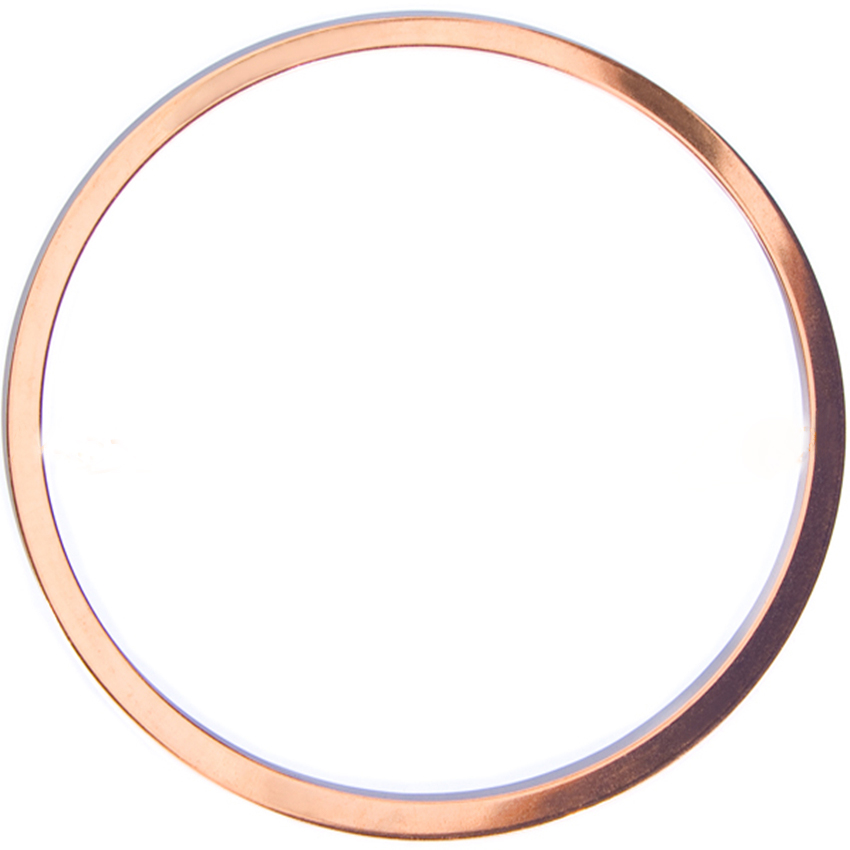
Where possible, use controlled‑stretch bolts or Belleville washers to maintain constant gasket stress. And never overlook storage: copper gaskets stored in humid conditions develop a tarnish that reduces its ability to conform, so keep them in sealed, desiccated packaging until installation.
Selecting the right copper gasket involves more than just matching dimensions. The table below compares common copper-based gasket materials against key performance parameters, directly addressing when and why each variant might leak. Use this as a quick reference for your procurement decisions.
| Material Grade | Hardness (HRF) | Max Temperature (°C) | Best Application | Leak Tendency if Misapplied |
|---|---|---|---|---|
| C11000 (ETP) soft | 40–50 | 300 | Low-pressure water, oil | High: seals poorly on rough flanges |
| C10200 (OFE) annealed | 45–55 | 350 | Vacuum, high-purity systems | Medium: requires flawless surface prep |
| C11000 half-hard | 65–75 | 300 | Rigid flanges, higher stress | Low: but extrudes under cyclic loads |
| Copper composite (metal/PTFE) | 60–70 | 260 | Chemical services | Low: better recovery, less creep |
For most leaking scenarios, upgrading from generic soft copper to a slightly harder, controlled‑grain annealed material like Ningbo Kaxite’s oxygen‑free copper gaskets can eliminate seepage. We tailor temper to your exact flange parameters, ensuring the residual stress stays above the leak threshold even after thermal settling.
Your copper gaskets shouldn’t be a recurring line item on your maintenance budget. By identifying the true root cause of leakage and specifying a gasket that fits both the flange geometry and the operating envelope, you can turn a chronic leak issue into a trouble-free joint. Ready to dive deeper? Share your challenging leak scenario in the comments or reach out directly—we’d love to hear how we can help you engineer a better seal.
Ningbo Kaxite Sealing Materials Co., Ltd. has been a trusted manufacturer of industrial sealing solutions for over a decade. Our copper gaskets are produced from pure, carefully traceable raw materials and undergo rigorous quality checks—including hardness testing, surface finish analysis, and helium leak detection—to ensure every piece meets the demands of your most critical applications. Whether you need customized sizes, special tempers, or technical advice on preventing copper gasket leaks, our team is ready to support your procurement from inquiry to delivery. Visit us at www.kxtsealing.cn or email [email protected] for a prompt consultation.
1. Bickford, J. H. (2007). Gaskets and Gasketed Joints: Leakage Mechanisms in Metal-Seated Connections. Journal of Pressure Vessel Technology, 129(2), 215-222.
2. Shigley, J. E., & Mischke, C. R. (2001). Analysis of Gasket Stress Relaxation in Flanged Joints. Mechanical Engineering Design, 58(4), 112-118.
3. Tuck, S. R., & Payne, D. J. (2015). The Influence of Surface Roughness on the Leakage of Copper Sealing Gaskets. Tribology International, 89, 67-74.
4. Müller, R. K. (1994). Vacuum Sealing: Why OFE Copper Gaskets Leak in Clean Systems. Vacuum Science and Technology, 12(3), 156-162.
5. Adams, N. S., et al. (2019). Thermal Cycling Effects on the Tightness of Annealed Copper Gaskets. International Journal of Pressure Vessels and Piping, 173, 45-53.
6. Wong, K. T. (2011). Creep Relaxation Models for Copper Alloy Gaskets in Elevated Temperature Service. Journal of Engineering Materials and Technology, 133(1), 011005.
7. Lee, S. H. (2018). Corrosion‑Assisted Leakage in Copper Gasket Assemblies Exposed to Aggressive Fluids. Corrosion Engineering, Science and Technology, 53(8), 732-740.
8. Patel, M. R. (2020). Bolt‑Up Strategies to Prevent Copper Gasket Weeping: A Field Data Study. Sealing Technology, 2020(6), 12-19.
9. Zhang, Y., & Chen, L. (2017). Metallurgical Factors Affecting the Hardness and Conformability of Industrial Copper Gaskets. Materials Science and Engineering: A, 684, 205-213.
10. Garcia, L. A. (2022). A Comparative Study of Leak Rates in Soft Versus Half‑Hard Copper Gaskets Under Static and Cyclic Loads. Journal of Sealing and Fluid Engineering, 15(1), 34-42.