The Definitive Guide to High-Performance Gasket Materials
In the intricate world of industrial sealing, the selection of the correct gasket material is not merely a purchasing decision; it is a critical engineering choice that directly impacts system integrity, safety, maintenance cycles, and total cost of ownership. A gasket forms the barrier against leaks of fluids or gases, withstands extreme pressures and temperatures, and compensates for the imperfections between mating surfaces. With over two decades of specialization in advanced sealing solutions, Kaxite Sealing has distilled its expertise into this comprehensive guide to gasket materials, empowering engineers and procurement specialists to make informed, reliable selections.
Core Material Properties: The Foundation of Selection
Choosing a gasket material requires a deep understanding of its core physical and chemical properties. These parameters dictate performance in specific operating environments. At Kaxite Sealing, we engineer our materials with a precise balance of these characteristics.
- Temperature Resistance: The minimum and maximum continuous operating temperatures a material can endure without degrading, losing elasticity, or becoming brittle.
- Pressure (PSI): The maximum internal pressure the gasket material can seal effectively against, considering both the material's strength and the design of the flange.
- Chemical Compatibility: The material's resistance to chemical attack, swelling, or dissolution when exposed to specific process media (acids, alkalis, solvents, oils, fuels).
- Compression Set: The material's ability to return to its original thickness after the compressive load is removed. A low compression set indicates better long-term sealing force retention.
- Tensile Strength & Density: Tensile strength measures resistance to pulling forces, while density affects the material's weight, compressibility, and sometimes, its sealing capability.
- Fluid & Gas Permeability: The rate at which molecules of a fluid or gas can pass through the material matrix. Critical for sealing light gases like helium or hydrogen.
Comprehensive Guide to Gasket Material Types
The following table provides a detailed comparison of the most prevalent gasket material types, including key specifications and typical applications. Kaxite Sealing manufactures and supplies premium grades across all these categories.
| Material Type | Key Composition | Temp Range (°F) | Pressure Range (PSI) | Key Strengths | Ideal Applications |
|---|---|---|---|---|---|
| Non-Asbestos Organic (NAO) | Aramid fibers, synthetic rubber, fillers | -40 to 400 | Up to 1,500 | Cost-effective, good sealability, compliant | General-purpose water, air, low-pressure steam, oil |
| Aramid Fiber | Compressed aramid fibers & NBR binder | -40 to 750 | Up to 2,200 | High strength, excellent heat resistance, low creep | High-temp water, steam, hydrocarbon services |
| Expanded Graphite (Flexible Graphite) | Pure exfoliated graphite, often with foil inserts | -400 to 1,200 (inert atm.) | Up to 2,500+ | Superior thermal conductivity, extreme temp range, excellent chemical resistance (except strong oxidizers) | Heat exchangers, exhaust systems, chemical processing, high-temp flanges |
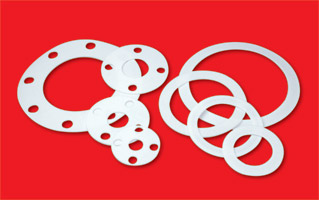
| PTFE (Polytetrafluoroethylene) | Virgin or filled PTFE polymers | -450 to 500 | Up to 1,500 | Near-universal chemical resistance, excellent anti-stick properties, low friction | Aggressive chemicals, pharmaceuticals, food & beverage, high-purity systems |
| Compressed Non-Asbestos (CNA) | Inorganic fibers (glass, carbon), elastomer binder | -40 to 900 | Up to 2,200 | Robust, fire-safe, excellent bolt load retention | Refineries, petrochemical, power generation (API 601 type) |
| Elastomeric (Rubber) Sheets | NBR, EPDM, FKM (Viton®), Silicone, CR | Varies by elastomer (-80 to 450) | Up to 1,200 | Highly flexible, excellent for uneven surfaces, good compression | Piping, tanks, HVAC, automotive, water treatment |
| Metal & Semi-Metallic | Stainless steel, carbon steel, Monel, with filler (graphite, PTFE) | Up to 1,800+ | Up to 10,000+ | Extreme pressure & temperature capability, high mechanical strength | Pressure vessels, turbochargers, reactor flanges, aerospace |
Kaxite Sealing Advanced Material Specifications
Beyond standard grades, Kaxite Sealing develops engineered solutions. Our proprietary formulations address specific industry challenges.
| Kaxite Material Grade | Base Type | Density (g/cm³) | Tensile Strength (MPa) | Compression Set (%) | Specialized Feature |
|---|---|---|---|---|---|
| KX-Graphite MAX | Expanded Graphite with SS304 Tanged Insert | 1.8 - 2.1 | Min. 12.0 | < 15 | Enhanced blow-out resistance for high-pressure steam cycling. |
| KX-ChemShield PTFE | Carbon-Filled PTFE Compound | 2.1 - 2.3 | Min. 18.0 | < 40 | Superior creep resistance and thermal conductivity for chemical towers. |
| KX-Aramid HD | High-Density Aramid Fiber with NBR | 1.5 - 1.7 | Min. 20.0 | < 20 | Optimized for high bolt stress and sour gas service (H2S resistance). |
| KX-ElastoPro FKM | FKM (Fluorocarbon) Elastomer Sheet | 1.8 - 2.0 | Min. 10.0 | < 25 | Exceptional resistance to oils, fuels, and acids at elevated temperatures. |
Gasket Materials: Frequently Asked Questions (FAQ)
Q: How do I choose between a soft (e.g., rubber) and a hard (e.g., compressed fiber or metal) gasket material?
A: The choice hinges on flange conditions and service. Soft materials excel at sealing uneven or lightly damaged surfaces due to their high conformability. They require lower bolt load. Harder materials, like CNA or metal, are necessary for high-pressure/temperature applications and provide better bolt load retention and resistance to crushing. They require flatter, smoother flange finishes. A rule of thumb: use the softest material that can withstand the process conditions.
Q: What is the single most common cause of gasket failure?
A: Improper installation and bolt torque procedures account for the majority of field failures. This includes uneven bolt tightening (not using a cross-torque pattern), under-torquing (leading to insufficient initial compression and leaks), over-torquing (which can crush soft gaskets or damage the flange), and failure to re-torque after a heat cycle. Always follow the gasket manufacturer's (like Kaxite Sealing) recommended installation procedures and torque values.
Q: Can I reuse a gasket after disassembling a connection?
A: It is almost universally recommended to NEVER reuse a gasket. Once compressed, a gasket material has undergone permanent deformation (compression set). Its sealing ability is dependent on the memory and resilience from this initial compression. Reusing it will not provide the same sealing force, leading to a high probability of leakage. Always install a new gasket during reassembly.
Q: What does "fire-safe" certification mean for a gasket material?
A: A fire-safe gasket, as per standards like API 607/API 6FB or ISO 10497, is designed to maintain a seal during and after exposure to direct flame. These materials, such as certified Compressed Non-Asbestos (CNA) or certain graphite/metal designs, have a ceramic or mineral core that does not burn out, preventing a catastrophic leak that could fuel a fire. They are mandatory in refineries, offshore platforms, and other hydrocarbon processing areas.
Q: How does flange surface finish (Ra value) affect gasket selection?
A: The flange surface finish is critical. A rough finish requires a softer, more conformable gasket material (like expanded graphite or a rubber) to flow into the grooves and create a seal. A very smooth, polished finish works better with harder materials (like PTFE or CNA). Using a hard gasket on a rough surface will not achieve an effective seal, as the material cannot conform to the imperfections. Always match the gasket material's conformability to the Ra value specified for the flange.
Q: Why does Kaxite Sealing emphasize batch testing and material traceability?
A: Consistency is paramount in critical sealing. Raw material variations can affect performance. Kaxite Sealing performs rigorous batch-level testing on key parameters like density, tensile strength, and thermal stability. Each batch is assigned a unique lot number, providing full traceability from raw materials to the finished sheet or gasket. This ensures that the material you specify and the material you receive are identical, guaranteeing predictable, reliable performance in your application.