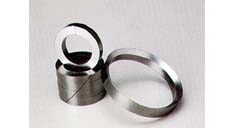
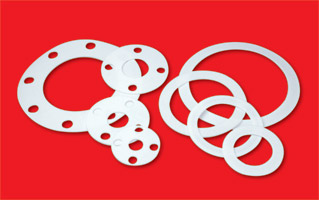
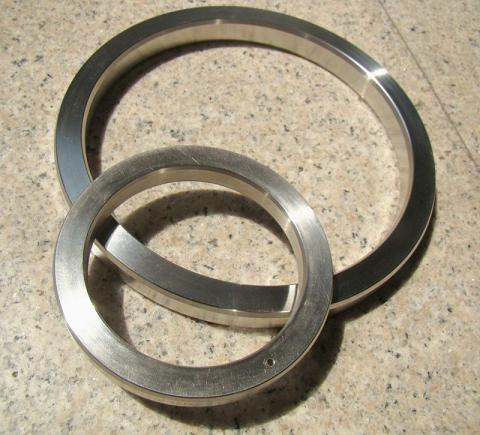
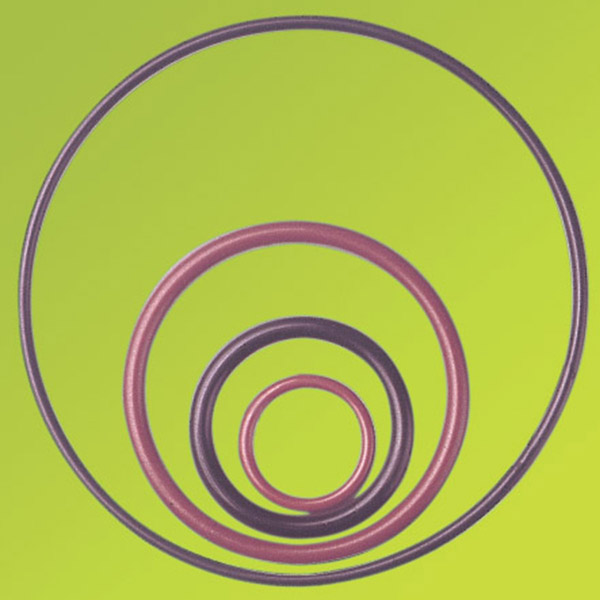
Die-formed graphite rings, also known as pressed graphite rings or molded graphite rings, represent a pinnacle of engineered sealing technology. Unlike their machined-from-billet counterparts, these rings are manufactured by compressing high-purity graphite flake or powder within precision dies under specific temperatures and pressures. This die-forming process yields components with exceptional dimensional consistency, structural integrity, and homogeneous material properties, making them a superior choice for demanding static sealing applications across a multitude of industries. At Kaxite Sealing, we have perfected this art, producing die-formed graphite rings that set the benchmark for reliability, performance, and cost-effectiveness in sealing solutions.
The die-forming process is fundamentally what distinguishes these rings. It allows for the mass production of rings with complex cross-sections—such as oval, rectangular, or other proprietary profiles—that are difficult or economically unviable to machine. This results in a product with no inherent structural weaknesses from machining directions, offering uniform strength and sealing characteristics in all directions. The process also enables excellent surface finish straight from the mold, often reducing the need for secondary machining operations.
**Primary Applications and Industries Served**
Die-formed graphite rings from Kaxite Sealing are indispensable in environments where resilience under extreme conditions is non-negotiable. Their primary function is to create a leak-tight seal between two stationary surfaces (flanges, heat exchangers, etc.). Key industries that rely on our expertise include:
* **Chemical & Petrochemical Processing:** Sealing aggressive acids, alkalis, solvents, and hydrocarbons in reactors, columns, and piping systems.
* **Power Generation:** Used in flange connections in boilers, turbines, and heat recovery systems, handling high-temperature steam and hot gases.
* **Oil & Gas (Upstream & Midstream):** Ideal for sealing in valves, compressor casings, and manifold systems exposed to high pressure and corrosive media.
* **Pharmaceutical & Food Processing:** Providing clean, non-contaminating seals for sanitary processes, often with FDA-compliant material grades.
* **Steel & Primary Metals:** Withstanding the intense heat and thermal cycling in furnaces, coke oven doors, and annealing lines.
* **Aerospace & Defense:** Used in specialized static applications requiring lightweight, high-temperature resistant seals.
**Key Advantages of Kaxite Sealing Die-formed Graphite Rings**
Choosing our die-formed rings brings a host of technical and operational benefits:
1. **Superior Dimensional Consistency & Repeatability:** The die-forming process guarantees that every ring, from the first to the ten-thousandth, meets exacting dimensional tolerances. This eliminates fitment issues and ensures predictable sealing performance in every installation.
2. **Excellent Chemical Inertness:** Our high-purity graphite materials are unaffected by most corrosive process fluids, ensuring long-term seal integrity even in the harshest chemical environments.
3. **Outstanding Thermal Stability:** They maintain sealing force and dimensional shape across a vast temperature range, from cryogenic applications to extreme heat, without melting or degrading.
4. **Self-Lubricating Properties:** The inherent lubricity of graphite reduces friction during installation and allows for slight thermal movement between flanges without galling or binding.
5. **High Thermal Conductivity:** This property helps dissipate heat away from the seal interface, reducing thermal stress on adjoining metal components.
6. **Cost-Effectiveness for High Volumes:** For standardized sizes and profiles, die-forming is significantly more economical than machining individual rings, offering substantial savings for large-scale projects.
**Detailed Product Parameters and Specifications**
To specify the correct die-formed graphite ring for your application, engineers must consider several key parameters. The following tables detail the standard specifications for Kaxite Sealing's core product line.
**Table 1: Standard Material Grades and Properties**
| Grade Code | Density (g/cm³) | Flexural Strength (MPa) | Compressive Strength (MPa) | Thermal Conductivity (W/m·K) | Max Continuous Operating Temp (°C) | Primary Characteristics |
| :--- | :--- | :--- | :--- | :--- | :--- | :--- |
| **KX-DFG-HP** | 1.75 - 1.85 | 25.0 | 55.0 | 70 | 450°C (in air) | High purity, general purpose, excellent chemical resistance. |
| **KX-DFG-HD** | 1.85 - 1.95 | 35.0 | 80.0 | 90 | 400°C (in air) | High density & strength, for higher pressure flange connections. |
| **KX-DFG-OX** | 1.80 - 1.90 | 28.0 | 60.0 | 65 | 550°C (in air) | Oxidation inhibited, extended service life in oxidizing atmospheres. |
| **KX-DFG-FD** | 1.70 - 1.80 | 22.0 | 50.0 | 60 | 350°C (in air) | FDA-compliant materials, suitable for food & pharmaceutical contact. |
**Table 2: Standard Cross-Section Profiles and Dimensions (Examples)**
| Profile Type | Cross-Section Diagram Code | Standard Width (W) Range | Standard Thickness (T) Range | Typical ASME B16.20 / B16.21 Equivalent | Best For |
| :--- | :--- | :--- | :--- | :--- | :--- |
| **Rectangular (Flat Ring)** | RECT | 3 mm to 25 mm | 1.5 mm to 6 mm | Style R (Ring Gasket) | Standard raised face (RF) flanges, general purpose. |
| **Oval (Octagonal)** | OVAL | 6.4 mm (1/4") | 4.5 mm to 6.4 mm | Style ROV (Ring-Oval) | RTJ (Ring Type Joint) flanges, high-pressure service. |
| **Double Beveled** | DBV | 10 mm to 30 mm | 3 mm to 8 mm | Proprietary Kaxite Design | Special flange facings requiring enhanced sealing line contact. |
| **Custom Profiles** | CUST | Customer Specified | Customer Specified | N/A | Unique applications, heat exchanger channels, etc. |
**Table 3: Standard Size Ranges and Tolerances (Per Kaxite Standard)**
| Parameter | Typical Range | Standard Tolerance (Unless Specified) |
| :--- | :--- | :--- |
| **Inside Diameter (ID)** | 15 mm to 3000 mm | ±0.2 mm (up to 500mm ID), ±0.3% of ID (above 500mm) |
| **Outside Diameter (OD)** | 25 mm to 3020 mm | ±0.2 mm (up to 500mm OD), ±0.3% of OD (above 500mm) |
| **Width (W)** | As per Table 2 | ±0.1 mm |
| **Thickness (T)** | As per Table 2 | ±0.05 mm |
| **Surface Finish** | As molded | Typically 3.2 μm Ra (can be machined to 1.6 μm Ra upon request) |
**Kaxite Sealing Die-formed Graphite Ring: Frequently Asked Questions (FAQ)**
**Q: What is the main difference between a die-formed graphite ring and a machined graphite ring?**
**A:** The core difference lies in the manufacturing process. A die-formed ring is created by compressing graphite material into a precise mold (die), resulting in a part with uniform grain structure and high dimensional consistency at high volumes. A machined ring is cut from a block or tube of graphite, which can be more suitable for prototypes, very large sizes, or low-volume custom shapes but may have directional properties and higher cost per piece for standard sizes.
**Q: What are the temperature limits for Kaxite die-formed graphite rings?**
**A:** In inert or reducing atmospheres, our standard graphite grades can function up to 3000°C. However, in air or oxidizing environments, oxidation begins around 400-450°C. Our standard grades (KX-DFG-HP/HD) are recommended for continuous use up to 400-450°C in air. For higher temperature oxidizing applications, our oxidation-inhibited grade (KX-DFG-OX) extends this range up to 550°C. Always consult our engineering team for specific service conditions.
**Q: Can die-formed graphite rings be used for high-pressure applications?**
**A:** Absolutely. The die-forming process creates a dense, homogeneous structure with high compressive strength, making them excellent for high-pressure static sealing. Our KX-DFG-HD grade is specifically engineered for such duties. They are commonly used in Ring Type Joint (RTJ) flanges in the oil & gas industry, which routinely handle pressures exceeding 10,000 psi (689 bar).
**Q: How do I select the correct cross-section profile for my flange?**
**A:** The profile must match the flange facing geometry. For standard ASME B16.5 raised face (RF) flanges, a rectangular cross-section ring is typical. For Ring Type Joint (RTJ) flanges (ASME B16.5 or B16.47), an oval (octagonal) cross-section ring is mandatory to fit the corresponding groove. Always refer to the original flange standards and specifications. Kaxite Sealing can provide guidance based on your flange drawings or specifications.
**Q: Are these rings brittle and difficult to handle during installation?**
**A:** While graphite is inherently a friable material, the die-forming process and our material formulations produce rings with good mechanical strength and handling properties for their intended use. They should be handled with reasonable care—avoid dropping or impacting them on hard edges. Installation is straightforward: the ring is placed cleanly between the flange faces, and the bolts are tightened evenly and gradually to the specified torque.
**Q: Do Kaxite graphite rings require a sealant or adhesive?**
**A:** Generally, no. High-quality die-formed graphite rings are designed to seal directly on clean, smooth metal surfaces. The combination of flange bolt load and the ring's conformability creates an effective gas-tight or liquid-tight seal. The use of sealants is not recommended as they can interfere with the graphite's performance and contaminate the system. For severely pitted or damaged flange faces, remediation of the surface is preferred over relying on a sealant.
**Q: What information do I need to provide to Kaxite Sealing to get a quote for custom rings?**
**A:** To ensure an accurate and fast quotation, please provide the following: 1) A detailed dimensional drawing (ID, OD, Width, Thickness, Profile shape). 2) Application details (fluid/media, temperature, pressure). 3) Required material grade (or let us recommend based on service). 4) Quantity required. 5) Any applicable industry standards (ASME, DIN, JIS, etc.).
**Q: What are the lead times for standard versus custom die-formed rings?**
**A:** For standard sizes and profiles from our catalog, Kaxite Sealing typically maintains stock or can produce with short lead times of 2-4 weeks. For fully custom rings requiring new die fabrication, lead times are longer, usually 6-8 weeks, as this includes die design, manufacturing, and sample approval. We prioritize projects and can often expedite based on critical need.