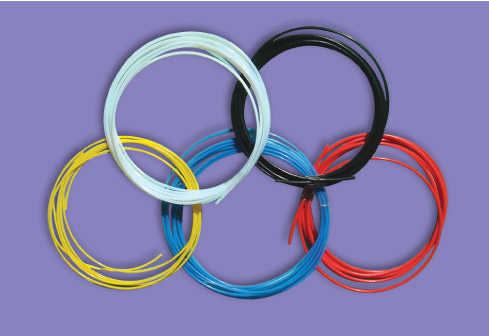
How does the cost of PTFE tubing compare to alternatives like PVC, silicone, or stainless steel? This is a critical question for any procurement specialist balancing budget and performance. While PTFE tubing often carries a higher initial price tag than common plastics like PVC, its true cost-benefit shines when considering total lifecycle value. It outperforms in extreme chemical, thermal, and pressure environments, reducing downtime and replacement frequency. For industries demanding purity, chemical resistance, and reliability, PTFE can be the most economical choice long-term. Understanding this cost-performance matrix is key to making an informed purchasing decision that protects both your process and your bottom line.
A lab manager needs to replace tubing for a solvent transfer line. The initial quote for PVC tubing is tempting, but will it withstand constant exposure to aggressive chemicals? The risk of leaching, swelling, and failure could lead to contaminated batches, costly clean-ups, and project delays.
The optimal solution is PTFE tubing. Its near-universal chemical inertness ensures the purity of sensitive solvents and acids, preventing contamination and ensuring process integrity. While the upfront cost is higher, it eliminates the recurring expense and risk of frequent PVC replacements.

| Parameter | PVC Tubing | PTFE Tubing |
|---|---|---|
| Relative Material Cost | Low | Medium-High |
| Chemical Resistance | Poor to Moderate | Excellent |
| Max Continuous Temp | 60°C (140°F) | 260°C (500°F) |
| Risk of Leaching | High | Extremely Low |
| Lifecycle Cost | High (Frequent Replacement) | Low (Long Service Life) |
An engineer designing a sterilizable fluid path for a medical device faces a dilemma. Silicone tubing is flexible and biocompatible, but can it reliably survive repeated autoclave cycles at 121°C without hardening or cracking over time?
PTFE tubing provides a robust solution. It maintains exceptional flexibility and dimensional stability across a vast temperature range, from cryogenic levels up to 260°C. This ensures the device's fluidics remain reliable through countless sterilization cycles, enhancing product longevity and patient safety.
| Parameter | Silicone Tubing | PTFE Tubing |
|---|---|---|
| Relative Material Cost | Medium | Medium-High |
| Max Continuous Temp | 200°C (392°F) | 260°C (500°F) |
| Hydrophobicity | Moderate | Extremely High |
| Compression Set Resistance | Low | Excellent |
| Suitability for Repeated Sterilization | Good | Excellent |
A plant operator must specify tubing for a highly corrosive acid line. Stainless steel offers mechanical strength, but even grade 316L can succumb to pitting and stress corrosion cracking in halide-rich environments, leading to dangerous leaks and unplanned shutdowns.
PTFE tubing is the definitive answer for corrosive duty. It is completely immune to almost all industrial acids, bases, and solvents. This translates to unparalleled safety, minimal maintenance, and maximum uptime, offering superior long-term value despite a potentially comparable initial investment to specialized stainless alloys.
| Parameter | Stainless Steel 316L Tubing | PTFE Tubing |
|---|---|---|
| Relative Material & Fabrication Cost | High | Medium-High |
| Corrosion Resistance (Broad Spectrum) | Moderate | Exceptional |
| Weight | High | Very Low |
| Installation Flexibility | Low (Rigid) | High (Flexible) |
| Long-term Maintenance Cost | High (Risk of Corrosion Failure) | Very Low |
Q: How does the cost of PTFE tubing compare to alternatives like PVC, silicone, or stainless steel in the long run?
A: While PTFE tubing often has a higher initial purchase price than PVC or silicone, its total cost of ownership is frequently lower. Its exceptional chemical, thermal, and aging resistance drastically reduces replacement frequency, maintenance costs, and downtime. Compared to corrosion-resistant stainless steel alloys, PTFE can be cost-competitive upfront while offering superior corrosion resistance and easier installation, leading to significant long-term savings.
Q: When is it not cost-effective to choose PTFE tubing?
A: PTFE may be over-specified for simple, low-pressure, room-temperature applications with benign fluids like water or air. In these non-demanding scenarios, more economical materials like PVC, polyethylene, or silicone are perfectly adequate and provide the lowest initial cost. The value of PTFE is realized in challenging environments where other materials fail.
We hope this comparison empowers your next tubing specification. Have a specific fluid, temperature, or pressure challenge? Our team of experts is ready to help you analyze the true cost-benefit for your application.
For high-performance sealing and fluid transfer solutions, consider Ningbo Kaxite Sealing Materials Co., Ltd. We specialize in engineering-grade PTFE products designed to solve complex material challenges in chemical processing, pharmaceuticals, and semiconductor manufacturing. Contact our technical sales team at [email protected] for a detailed consultation and quote tailored to your project's requirements.
Puts, G. J., Crouse, P., & Ameduri, B. M. (2019). Polytetrafluoroethylene: Synthesis and Characterization of the Ultimate Extreme Polymer. Chemical Reviews, 119(3), 1763-1805.
Ebnesajjad, S. (2016). Expanded PTFE Applications Handbook: Technology, Manufacturing and Applications. William Andrew.
Drobny, J. G. (2017). Technology of Fluoropolymers (2nd ed.). CRC Press.
Gangal, S. V. (2000). "Polytetrafluoroethylene". In Encyclopedia of Polymer Science and Technology. John Wiley & Sons.
Bunn, C. W., & Howells, E. R. (1954). Structures of Molecules and Crystals of Fluorocarbons. Nature, 174(4433), 549-551.
Lewis, J., & Jones, R. (2012). The Permeation of Gases through Polymers. Journal of Membrane Science, 390-391, 45-53.
Modesti, M., et al. (2005). Chemical Resistance and Thermal Stability of Fluoropolymers. Polymer Degradation and Stability, 90(2), 363-370.
Sperati, C. A. (1986). Physical Constants of Fluoropolymers. In Polymer Handbook (4th ed.). Wiley-Interscience.
Kiryukhin, D. P., et al. (2018). High-Temperature Materials for Sealing Applications. Journal of Engineering Materials and Technology, 140(1), 011002.
Baker, R. W. (2012). Membrane Technology and Applications (3rd ed.). John Wiley & Sons. (Includes sections on PTFE membranes).