If you have ever faced a sudden leak on a heat exchanger or a flange joint at 2 a.m., you already know that the price of a gasket itself is rarely the real problem. How much does it cost to replace a gasket? For many procurement and maintenance teams, the visible invoice for a single gasket can range from a few dollars for standard rubber sheets to over $300 for large PTFE or spiral wound gaskets. But the true cost includes labor, crane or confined space entry, process shutdown, overtime pay, and lost production. In food, chemical, and power plants, a single unplanned gasket replacement can easily add up to $5,000–$50,000 when downtime is counted. That is why sourcing the right gasket from a reliable manufacturer is not just a purchasing decision—it is a cost control strategy. Ningbo Kaxite Sealing Materials Co., Ltd. helps buyers reduce these risks through consistent material quality, custom dimensions, and fast export support.
Table of Contents
Imagine a procurement manager at a mid-sized chemical plant receives an urgent call: a flange on a steam line is leaking, and maintenance needs a replacement gasket before the next shift. The team asks for a 6-inch PTFE gasket with a specific thickness. The purchasing department quickly compares quotes. A standard 6-inch PTFE gasket may cost $8–$15 from one supplier, but if the gasket has to be custom cut or meet FDA or chemical resistance specifications, the price can jump to $40–$120 per piece. However, the gasket price is only one line item.
Labor costs often range from $75 to $150 per hour in North America and Europe. A two-person maintenance crew may need three to six hours to isolate the line, remove the old gasket, clean flange surfaces, torque bolts properly, and perform leak testing. That totals $450–$1,800 in labor alone. Add crane rental or scaffolding if the flange is in a hard-to-reach location, and the bill increases by another $500–$2,000. Then there is downtime: one hour of lost production in a food or chemical plant can cost $1,000–$20,000 depending on throughput.
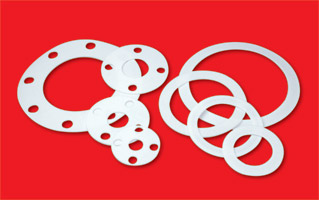
The solution is not to buy the cheapest gasket, but to select a gasket that fits the operating temperature, pressure, chemical compatibility, and flange load. When buyers work with Ningbo Kaxite Sealing Materials Co., Ltd., they receive material data sheets, dimensional checks, and packaging that prevents damage during shipping—all factors that reduce the risk of repeat replacement.
| Cost Component | Low Range | High Range | Notes |
|---|---|---|---|
| Gasket material | $5 | $300+ | Depends on size, material, and certification |
| Labor | $450 | $1,800 | Two-person crew, 3–6 hours |
| Equipment access | $0 | $2,000 | Scaffolding, crane, or confined space entry |
| Downtime | $1,000 | $20,000+ | Per hour in high-output plants |
| Logistics and testing | $50 | $500 | Express shipping, leak testing, re-inspection |
Picture a food processing plant that runs a saturated steam line at 150 psi. Maintenance replaces a compressed fiber gasket every six months because the material softens and leaks under thermal cycling. Each replacement costs about $1,200 in labor and $800 in downtime, but the real problem is that the wrong material was selected. A switch to a PTFE or filled PTFE gasket rated for steam and thermal cycling could extend the replacement interval to three years or more, cutting annual costs by over 60%.
In another scenario, an oil and gas facility uses spiral wound Gaskets on a high-pressure heat exchanger. The gaskets fail because the flange surface is not cleaned properly before installation, or the bolt torque is uneven. The immediate cost of replacing a gasket might be $300, but a blowout can force an emergency shutdown costing $50,000 in lost production. The solution includes operator training, torque wrenches, and gaskets with controlled compression characteristics.
| Failure Mode | Typical Cause | Preventive Solution | Estimated Cost Impact |
|---|---|---|---|
| Chemical attack | Wrong material for media | Use PTFE or chemically resistant gaskets | Reduces replacement frequency by 50–80% |
| Thermal cycling | Material loses resilience | Use filled PTFE or flexible graphite | Cuts downtime-related losses |
| Improper installation | Uneven bolt torque | Train crews, use torque wrenches | Avoids premature failure and rework |
| Flange damage | Corroded or scratched surface | Resurface flanges before installation | Prevents repeated leak paths |
When procurement teams ask how much does it cost to replace a gasket, the answer depends on a simple formula: Total Cost = (Gasket Price × Quantity) + Labor Hours × Labor Rate + Downtime Cost + Logistics + Testing or Inspection. Calculating this before an emergency allows buyers to compare suppliers on total cost of ownership rather than unit price alone.
For example, a 10-inch PTFE gasket might cost $85 per piece from one supplier and $120 from another. The cheaper supplier may have longer lead times, weaker packaging, or inconsistent dimensions. If the lower-priced gasket arrives damaged or fails after three months, the total cost is far higher than the $35 savings. A quick table makes this clear.
| Cost Element | Low-Cost Supplier | Quality Supplier |
|---|---|---|
| Gasket price | $85 | $120 |
| Labor | $800 | $800 |
| Downtime | $2,500 | $2,500 |
| Expected service life | 4 months | 18 months |
| Annualized replacement cost | $10,155 | $2,280 |
One of the most common pain points for buyers is receiving a gasket that fails because the material was not suited to the process. A gasket that costs $3 can cause a $30,000 shutdown if it is not compatible with the media or temperature. The solution is to evaluate the operating conditions before ordering: temperature, pressure, chemical exposure, and flange type. Different materials perform better in different environments.
For general water and low-pressure steam, rubber or fiber gaskets may be acceptable. For aggressive acids, solvents, or high temperatures, PTFE and flexible graphite are more reliable. Ningbo Kaxite Sealing Materials Co., Ltd. supplies a range of materials including pure PTFE, filled PTFE, expanded PTFE, graphite, and non-asbestos fiber sheets. Each material can be cut to custom dimensions or supplied as full sheets for on-site fabrication.
| Material | Temperature Range | Pressure Rating | Chemical Resistance | Relative Cost per Sheet |
|---|---|---|---|---|
| Non-asbestos fiber | -50°C to 200°C | Medium | Good for oils and water | Low |
| PTFE (pure) | -200°C to 260°C | Low to medium | Excellent | High |
| Filled PTFE | -200°C to 260°C | Medium | Excellent | Medium to high |
| Flexible graphite | -200°C to 450°C | High | Good with steam and chemicals | Medium |
| Rubber | -30°C to 100°C | Low | Limited | Low |
PTFE gaskets are often specified in chemical, pharmaceutical, and food processing plants because they resist almost all chemicals and operate across a wide temperature range. However, pure PTFE can creep under load, which leads to bolt relaxation and leaks over time. The solution is to use filled PTFE, which adds glass, carbon, or barium sulfate to improve dimensional stability and reduce creep. Expanded PTFE is another option that offers excellent conformability on uneven or damaged flange surfaces.
From a cost perspective, a pure PTFE gasket may cost $12 for a 4-inch ANSI 150 flange, while a filled PTFE gasket might cost $18–$25. The filled version lasts two to three times longer under cyclic conditions, so the effective cost per year is lower. Buyers who source from Ningbo Kaxite Sealing Materials Co., Ltd. can request specific fillers, thicknesses from 0.5 mm to 6 mm, and sheet sizes up to 1500 mm × 1500 mm.
| Grade | Creep Resistance | Best Use Case | Relative Price |
|---|---|---|---|
| Pure PTFE | Low | Low-pressure, static seals with smooth flanges | 1.0× |
| Glass-filled PTFE | Medium | Acids, alkalis, and moderate pressure | 1.4× |
| Carbon-filled PTFE | Higher | Steam, hydrocarbons, and thermal cycling | 1.6× |
| Expanded PTFE | Very high | Damaged or irregular flange surfaces | 2.0× |
For a purchasing manager, the worst outcome is not paying a few extra dollars for a gasket—it is paying for repeated shutdowns because the gasket was wrong or arrived late. Ningbo Kaxite Sealing Materials Co., Ltd. focuses on solving exactly that problem. The company supplies industrial gaskets and sealing sheets in materials such as PTFE, graphite, and non-asbestos fiber, with custom cutting according to customer drawings or sample measurements.
Instead of buying from multiple local distributors with inconsistent quality, buyers can source directly from the manufacturer. Kaxite provides material certificates, dimensional inspection before packing, and export-grade packaging that prevents bending or moisture damage during sea or air freight. The result is a lower total cost of ownership because the gaskets fit correctly, install faster, and last longer. For projects with tight deadlines, the sales team can arrange express production and shipping.
Q: How much does it typically cost to replace a gasket in industrial piping?
A: In most industrial settings, replacing a single gasket costs between $150 and $800 when you include labor, basic access, and the gasket itself. For large-diameter flanges, confined spaces, or high-pressure systems, the total can exceed $2,000 per joint. Emergency replacements cost more because of overtime and expedited shipping. The gasket material price is usually only 5% to 20% of the total replacement cost.
Q: What hidden costs should I include when estimating gasket replacement cost?
A: Hidden costs include production downtime, product loss, overtime wages, crane or scaffolding rental, cleaning solvents, flange resurfacing, bolt replacement, torque equipment, and post-repair leak testing. In food, chemical, and energy plants, downtime alone can cost $1,000 to $20,000 per hour. A reliable sealing supplier like Ningbo Kaxite Sealing Materials Co., Ltd. helps minimize these hidden costs by providing dimensionally accurate gaskets that reduce installation time and extend service life.
Are you still calculating the true cost of gasket replacement? If your team has experienced repeated leaks, high downtime, or inconsistent gasket quality, the next step is to audit your sealing specification rather than accept another emergency repair. Share your most expensive gasket failure in the comments or contact a sealing engineer to review your application.
Ningbo Kaxite Sealing Materials Co., Ltd. is a China-based manufacturer specializing in industrial gasket sheets, PTFE gaskets, graphite gaskets, and non-asbestos sealing materials. The company supports global buyers with custom dimensions, material selection guidance, stable quality control, and export-ready packaging. Visit https://www.kxtsealing.cn or email [email protected] to request a quote or discuss your sealing requirements.
Bickford, J. H., & Payne, J. R. (1988). Gasket behavior and its influence on bolted flange joint performance. Journal of Pressure Vessel Technology, 110(3).
Nau, B. S. (1995). Mechanical seals and gaskets: a review of current developments. Sealing Technology, 1995(18).
Abid, M., & Nash, D. H. (2004). Comparative study of the behaviour of different gasket materials for bolted flanged joints. Proceedings of the Institution of Mechanical Engineers, Part E: Journal of Process Mechanical Engineering, 218(4).
Sawa, T., & Ogata, N. (2002). Stress analysis and the sealing performance evaluation of pipe flange connections with gaskets under internal pressure. Journal of Pressure Vessel Technology, 124(3).
Fukuoka, T., & Takaki, T. (2001). Finite element analysis of bolted flange joints with gaskets. Journal of Pressure Vessel Technology, 123(4).
Kobayashi, T. (2006). Long-term sealing performance of PTFE gaskets in chemical environments. Sealing Technology, 2006(11).
Veiga, J. C., & Girao, G. (2014). Performance of non-asbestos gaskets in chlorine service. Sealing Technology, 2014(5).
Nagata, S., & Shoji, Y. (2010). Effect of gasket creep relaxation on bolted flange joint integrity. International Journal of Pressure Vessels and Piping, 87(7).
Reid, D. A., & Palmer, H. T. (2017). Cost-based selection of industrial gaskets for chemical processing plants. Journal of Loss Prevention in the Process Industries, 48.
Chen, L., & Zhao, W. (2020). Comparative lifecycle cost analysis of PTFE and graphite gaskets in high-temperature flanged connections. Engineering Failure Analysis, 115.